Check this site out:
World Mapper
It's stunning to see in grapic detail how little the USA exports to the rest of the world. No wonder our trade deficit is so hard to balance!
When you're building a stronger business, you've got to know the big picture.
Friday, February 10, 2006


What Hotels Know About You
Hotels know a lot about you. They may keep track of your pillow preferences, your food choices, and even your favorite sports team - all in the hopes of providing great customer service. Here's a summary of what certain hotels are currently doing to help win you over, as reported recently in The Wall Street Journal.
The Ritz-Carlton has a new database called Mystique that catalogues employee observations about guests for all of the company's 60 hotels. It replaces an old system that couldn't share information as easily between hotels. Since this system relies on hotel staff to notice what guests like and dislike, it allows the company to tailor services without asking guests to fill out any forms.
Marriott's "Rewarding Welcome" system asks guests for their preferences in pillow type, bed type, room location, extra towels, or refrigerator. It now shares the information with eight brands, and 2,600 hotels. Guests fill out a form to participate, so the system is entirely optional.
This year Hilton's guest recognition technology is being expanded to include in-room preferences, such as pillow, blanket, need for a crib or rollaway, and early or late check in. In 2007, the hotel company hopes to roll out RFID-tagged cards for frequent guests to carry so that the hotel can track them around the property. This would allow a bartender to have a guest's favorite drink ready as soon as the guest walks in the bar, for example. The company is also testing a way for its TVs to greet guests with a customized message when turned on.
In April, Hyatt is rolling out an "e-concierge" system so that guests can tell the hotel in advance about their preferences for amenities like golf, spas, and restaurants. Hyatt currently has a centralized guest history system that captures preferences like room type, amenity type, bed type and location near or far from an elevator. It has special codes employees can log into the system for preferences such as a guest who prefers grapefruit peeled and sliced in a certain way.
Starwood (which includes brands like W Hotels, Westin, and Sheraton) doesn't have a tracking system other than its Starwood Preferred Guest Loyalty program. The properties on its more luxurious end, like W, have internal guest-recognition systems, however. If a guest expresses a love for a certain sports team, the welcome desk will always provide that guest with a game schedule and a list of TV channels on which the team is playing. W asks guests if they want information about preferences to remain with one property, or expect it to be honored throughout the chain.
Build a stronger business by paying attention to your customers and showing that they matter when they return.
The Ritz-Carlton has a new database called Mystique that catalogues employee observations about guests for all of the company's 60 hotels. It replaces an old system that couldn't share information as easily between hotels. Since this system relies on hotel staff to notice what guests like and dislike, it allows the company to tailor services without asking guests to fill out any forms.
Marriott's "Rewarding Welcome" system asks guests for their preferences in pillow type, bed type, room location, extra towels, or refrigerator. It now shares the information with eight brands, and 2,600 hotels. Guests fill out a form to participate, so the system is entirely optional.
This year Hilton's guest recognition technology is being expanded to include in-room preferences, such as pillow, blanket, need for a crib or rollaway, and early or late check in. In 2007, the hotel company hopes to roll out RFID-tagged cards for frequent guests to carry so that the hotel can track them around the property. This would allow a bartender to have a guest's favorite drink ready as soon as the guest walks in the bar, for example. The company is also testing a way for its TVs to greet guests with a customized message when turned on.
In April, Hyatt is rolling out an "e-concierge" system so that guests can tell the hotel in advance about their preferences for amenities like golf, spas, and restaurants. Hyatt currently has a centralized guest history system that captures preferences like room type, amenity type, bed type and location near or far from an elevator. It has special codes employees can log into the system for preferences such as a guest who prefers grapefruit peeled and sliced in a certain way.
Starwood (which includes brands like W Hotels, Westin, and Sheraton) doesn't have a tracking system other than its Starwood Preferred Guest Loyalty program. The properties on its more luxurious end, like W, have internal guest-recognition systems, however. If a guest expresses a love for a certain sports team, the welcome desk will always provide that guest with a game schedule and a list of TV channels on which the team is playing. W asks guests if they want information about preferences to remain with one property, or expect it to be honored throughout the chain.
Build a stronger business by paying attention to your customers and showing that they matter when they return.
A Good Alternate for Your Sweet Tooth
Did You Ever Wonder About...?
Thursday, February 09, 2006
Deadlines Come Out on Top
You better meet your deadlines if you want to succeed in your job, according to a survey of 150 executives by temporary accounting staff agency, Accountemps.
Asked what the single most important characteristic for the workplace is, 36% answered meeting deadlines.
Avoiding office politics and being pleasant to work with tied for second place with 20% each. Supporting your supervisor was the single most important characteristic for 17% of participants.
If you complete your work on time you will fulfill your clients and colleagues expectations and build a stronger business.
Asked what the single most important characteristic for the workplace is, 36% answered meeting deadlines.
Avoiding office politics and being pleasant to work with tied for second place with 20% each. Supporting your supervisor was the single most important characteristic for 17% of participants.
If you complete your work on time you will fulfill your clients and colleagues expectations and build a stronger business.
Monday, February 06, 2006
Highest Priorities Include Reactive and Proactive Steps
Look at this chart from Sage Research:
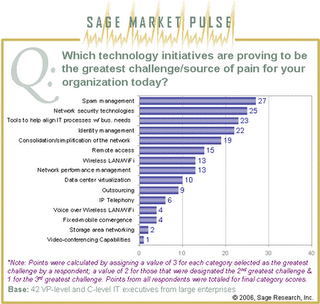
What I noticed immediately is that company IT leaders are mired in managing unwanted e-mail messages and preventing network security problems before they can get to their biggest return on tech investment, alignment with business goals.
Is your business in a similar situation?
Things have been different for the companies surveyed (as well as your company, perhaps), if 5 years ago you implemented simple policies and directory protection measures.
It always makes sense to spend a portion of your time looking ahead at what you can take care of now while it's a small matter.
It's a habit of company leaders who are focused on building a stronger business.
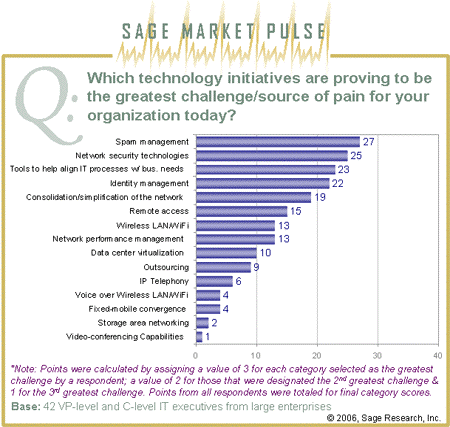
What I noticed immediately is that company IT leaders are mired in managing unwanted e-mail messages and preventing network security problems before they can get to their biggest return on tech investment, alignment with business goals.
Is your business in a similar situation?
Things have been different for the companies surveyed (as well as your company, perhaps), if 5 years ago you implemented simple policies and directory protection measures.
It always makes sense to spend a portion of your time looking ahead at what you can take care of now while it's a small matter.
It's a habit of company leaders who are focused on building a stronger business.
Sharp has rapidly carved out a niche for itself in the LCD TV market
Sharp Inc. has taken larger electronics companies by surprise by carving out a 23 percent share of the LCD market and becoming a market leader in a very competitive market.
Its latest product to build on its lead in the sector is a 65-inch Aquos LCD TV. Under Katsuhiko Machida’s tenure, Sharp has raised its profit margin to 5.9 percent, the highest among Japanese electronics producers for the fiscal year ending March 2005.
With sales of $2.5bn, the company enjoyed profits of $715 million. Machida. Sharp’s fourth president says he has benefited from the advice of his original predecessor, Tokuji Hayakawa, who counseled: “Create products that others will strive to imitate”.
When Machida took over a Sharp, he scaled back its semi-conductor business and took an enormous risk by investing 75% of the company’s annual capital outlay into a state-of-the-art LCD production facility, the only such plant to produce and assemble LCDs from beginning to end. Machida did this to avoid the worldwide practice of manufacturers to outsource, because he sought maximum quality control assurance. He later decided to expand the screen width from 40 inches to 45 inches.
Between World Cup Soccer Tournament in 2006 and the upcoming 2008 Olympics in Beijing the LCD sector is expected to see double-digit growth.
It flies in the face of conventional business practices to manufacture start to finish in a developed country but Machida believes he can maximize profits by managing tighter control over the entire process. If you can take an unconventional strategy and make it work, you’ll build a stronger business.
Its latest product to build on its lead in the sector is a 65-inch Aquos LCD TV. Under Katsuhiko Machida’s tenure, Sharp has raised its profit margin to 5.9 percent, the highest among Japanese electronics producers for the fiscal year ending March 2005.
With sales of $2.5bn, the company enjoyed profits of $715 million. Machida. Sharp’s fourth president says he has benefited from the advice of his original predecessor, Tokuji Hayakawa, who counseled: “Create products that others will strive to imitate”.
When Machida took over a Sharp, he scaled back its semi-conductor business and took an enormous risk by investing 75% of the company’s annual capital outlay into a state-of-the-art LCD production facility, the only such plant to produce and assemble LCDs from beginning to end. Machida did this to avoid the worldwide practice of manufacturers to outsource, because he sought maximum quality control assurance. He later decided to expand the screen width from 40 inches to 45 inches.
Between World Cup Soccer Tournament in 2006 and the upcoming 2008 Olympics in Beijing the LCD sector is expected to see double-digit growth.
It flies in the face of conventional business practices to manufacture start to finish in a developed country but Machida believes he can maximize profits by managing tighter control over the entire process. If you can take an unconventional strategy and make it work, you’ll build a stronger business.
Wednesday, February 01, 2006
Don't Network this Way!
For business owners, networking is a great way to expand your circle of contacts and increase your chances of meeting your next client, employee, or supplier.
However, this Washington Post story cautions us about the need to erase your personal phone numbers, PINS, and other secure info from your cell phone before turning it in or donating it.
With high end phones, this isn't always as easy as it seems. When I did this on a Kyocera phone last year, each entry had to be selected, deleted, and confirmed. Then you had to go back to the main menu, go to the Contacts list, and begin the process again.
It's worth the effort, though. Be safe and take this precaution.
Dealing with identity theft can range as a minor nuisance to a major distraction.
However, this Washington Post story cautions us about the need to erase your personal phone numbers, PINS, and other secure info from your cell phone before turning it in or donating it.
With high end phones, this isn't always as easy as it seems. When I did this on a Kyocera phone last year, each entry had to be selected, deleted, and confirmed. Then you had to go back to the main menu, go to the Contacts list, and begin the process again.
It's worth the effort, though. Be safe and take this precaution.
Dealing with identity theft can range as a minor nuisance to a major distraction.
Subscribe to:
Posts (Atom)


 Posts
Posts


